Nobody could have predicted that Angry Birds would dominate the world of mobile gaming. But it does, and it's all thanks to one company: Rovio. The Finnish gaming business' creation has been downloaded over a billion times, and 30 million users play daily.
Rumor has it that Rovio could go public one day, taking a page out of fellow gaming company Zynga's (NASDAQ: ZNGA ) playbook. Zynga is a much larger company with a more diverse roster of games, including Farmville and Words with Friends, but not long after the company's IPO, its stock dropped like a rock. Could Rovio be next?
Financials with friends
Rovio might be privately owned for now, but it has still revealed a few crucial tidbits about its income statement. The company hit Angry Birds pay dirt in 2009, and recently Rovio announced that its revenue in 2012 had doubled from 2011 to 152 million euros, or $199 million. Its net profit was impressive as well -- at $71.1 million, it held a healthy 35% margin, up 57% from last year.
2012's numbers were not so pleasant for Zynga, on the other hand. In March its stock reached a high of $14.69, but the company suffered a negative annual net income, after spending 86% of its revenue on research and development, as well as selling, general, and administrative expenses.
So what's the difference between these two companies? Are they simply at different points on the same trip to failure, or could Rovio avoid Zynga's fall?
Friending companies vs. friending consumers
Size isn't the only big difference between these two companies. Their strategies for generating revenue are surprisingly dissimilar as well. In 2012, Zynga gathered the bulk of its sales from its online gaming purchases and advertising, and thanks to its presence on Facebook, these revenues were staggering.
Rovio has of course made dough off of its games and ads, as well. However, there's one huge revenue generator that separates this company from Zynga: merchandise. From plush toys to Halloween costumes to hoodies, if you can think of it, there's an Angry Birds product for it. This accounted for 45% of the company's revenue last year, and Rovio has no plans to stop anytime soon. Chief Financial Officer Herkko Soininen recently expressed plans to create new entertainment offerings, including cartoons to feature films.
Selling merch is by no means a new tactic for gaming companies. Nintendo has sold paraphernalia based around its iconic plumber Mario for decades. Through this strategy, Rovio can focus less on the volatile world of mobile gaming and more on the promotion of beloved characters. If the company can continue reaping profits through merchandise while creating new games (and new characters to capitalize on), its moat could become wider than Zynga's.
That doesn't necessarily mean Rovio should go public. Angry Birds may be iconic, but there's no telling how popular any of Rovio's next offerings will be, and this kind of endeavor could take a lot of time and money to see through. An IPO may look tempting when a company needs capital, but Rovio's attentions would be spread too thin if it simultaneously focused on moving into video entertainment and appeasing shareholders. Still, Rovio's merchandise success proves that classic revenue-generating tactics can still be effective in a modern, mobile environment.
And then there's Zynga. This company's post-IPO performance has been dreadful, and investors are beginning to wonder if it's "game over" for this company. Turns out, being so closely tied to the world's largest social network can be a blessing and a curse. You can learn everything you need to know about Zynga and whether it's a buy or a sell in our new premium research report. Don't even think about picking up shares before you read what our top analysts have to say about Zynga. Click here to access your copy.

 Alamy April is Financial Literacy Month, and our goal is to help you raise your money IQ. In this series, we'll tackle key economic concepts -- ones that affect your everyday finances and investments -- to help you make smarter choices with every dollar decision you face. Today's term: net worth. In a nutshell, net worth is what you get when you subtract liabilities from assets -- what you owe from what you own. Like many economic and financial terms, net worth can apply in a variety of situations. If you're evaluating a company for your portfolio,you might glance at its balance sheet to get a handle on its net worth. Balance sheets break out assets (such as cash, inventory, and receivables) and liabilities (such as debt and accounts payable). Subtracting the latter from the former gives you net worth, which is also referred to in this context as shareholders' equity or book value. Here's an example: As of the end of 2012, IBM's (IBM) assets totaled $119 billion, and its liabilities totaled $100 billion. Thus, its net worth, or shareholders' equity, was $19 billion. Net Worth in Our Lives Each of us has an individual net worth, too, and it's arrived at in similar fashion. First, grab a sheet of paper and list all your assets. These would include the contents of your bank accounts, your investments, the equity you have in your home, your retirement accounts, the current value of your car(s), the value of your jewelry, the contents of your wallet or purse, and so on. Be thorough -- your sizable board game collection might be worth several thousand dollars, for example. Next, list all your liabilities, or debts. These would include what you owe on your mortgage or car loan, your credit card debt, any school loans outstanding, and any other debt, such as a home equity loan. Finally, subtract the liabilities from the assets. What's left is your net worth. Ideally, your net worth is positive and will grow over time. If your net worth is in negative territory, that's not great, but by saving aggressively, paying down your debts, and being careful in your spending you can reverse the situation over time. How Does Your Net Worth Compare? For the record, a typical net worth for an American family these days is between $100,000 and $200,000. The aggregate net worth of Americans has risen recently and is finally back to pre-recession levels. But much of those gains have gone to wealthy Americans and can be traced to the stock market's recovery. Middle-class Americans have about two-thirds of their net worth represented by their home equity, and home values have not recovered as much as the stock market at this point. The Dow Jones Industrial Average has more than doubled since its bottom about four years ago, while the national average home price is still some 30 percent below its peak. Other Reasons You Should Know Your Net Worth Knowing your net worth has practical value beyond just highlighting what you own and what you owe. It can also give you an idea of how well you're doing at saving for retirement. (Don't let seemingly large sums fool you -- even a million dollars at retirement may not be enough for some people's needs.) Net worth also matters when we engage in estate planning, as our estate is essentially our net worth. Deciding how to organize and manage your assets to minimize taxes and make things easy for your loved ones depends to some degree on the size of your estate, or net worth. So go ahead and calculate your net worth and see where you stand. . More money terms: Asset allocation Compound interest Opportunity cost
 Andy Dean Photography/Shutterstock Investors can afford to be aggressive when they're younger. But in their 50s or 60s? That aggressive manner should be mellowing down. Yet the vast majority of investors who are approaching retirement age are way too heavily invested in stocks. Investment company SigFig recently analyzed the asset allocation of more than 30,000 investors and compared that to their ideal allocation, based on their risk profile and investment horizon. The results: across all age groups, investment portfolios were too heavy on equities and too light on fixed income. Of baby boomers, only 3 percent of those in their 50s and 2 percent of those in their 60s had an allocation to fixed income investments that corresponded to their age risk tolerance, as determined by SigFig's questionnaire and an estimate of a well-balanced allocation.
  Bonds? What Bonds? A study released earlier this year by the Investment Company Institute, a mutual fund industry group, found that a third of investors in their 50s had 100 percent of their IRA accounts in stocks -- and so did a quarter of those age 60 to 64. For boomers easing into retirement, having 100 percent of their portfolio in equities probably doesn't feel too reassuring at times like the first half of this December, when the S&P 500 (^GPSC) fell more than 3.5 percent. More importantly, it's a risky strategy. You don't need to look back further than 2008-09 to know why.
 Spencer Platt/Getty Images WASHINGTON -- The number of Americans filing new claims for unemployment benefits fell last week to nearly its lowest level since before the 2007-09 recession, a sign of growing steam in the U.S. labor market. Initial claims for state unemployment benefits dropped 1,000 to a seasonally adjusted 287,000 in the week ended Oct. 4, the Labor Department said Thursday. Economists had expected claims to rise. The data adds to the view that strength is building in the U.S. economy. "The labor market is entering into a potential boom," said Joseph LaVorgna, chief U.S economist at Deutsche Bank (DB) in New York. Still, Federal Reserve officials remain concerned about persistently low rates of inflation and aren't seen in a rush to hike interest rates with the economies of key trading partners flagging. A separate report showed U.S. wholesale inventories rose by the most in four months in August, a sign the economy may have grown more than expected in the third quarter. Many economists think the economy grew at an annual rate of around 3 percent in the July-September period, much faster than average rates over the last few years. U.S. stocks opened lower as investors took profits after a big rally Wednesday that had been fueled by minutes of the Fed's last policy meeting, which suggested an interest rate hike could be delayed because of growing concerns on the international outlook. The U.S. dollar, which had been on a long run up through last week, slid to a three-week low against the Japanese yen Thursday, while yields on U.S. government debt rose modestly. Jobless claims have fallen steadily since the nation emerged from the recession and are currently lower than they were before the country's economic crisis began. Indeed, the level of claims last week was just 8,000 above a 14-year low reached in July. The four-week moving average of claims, considered a better measure of labor market trends as it irons out week-to-week volatility, fell 7,250 to 287,750, its lowest level since 2006. The Labor Department said there were no special factors influencing the state level claims data. The report showed the number of people still receiving benefits after an initial week of aid dropped 21,000 to 2.38 million in the week ended Sept. 27. "The gradual improvement in continuing claims is particularly encouraging and is consistent with recent declines in the unemployment rate, suggesting that unemployed workers continue to find gainful employment," said Gennadiy Goldberg, U.S. strategist at TD Securities in New York. -.
 Related BZSUM Dow Trades Above 17,000 While S&P 500 Inches Closer To 2,000 #PreMarket Primer: Thursday, July 3: Much To Consider Despite The Short Day
 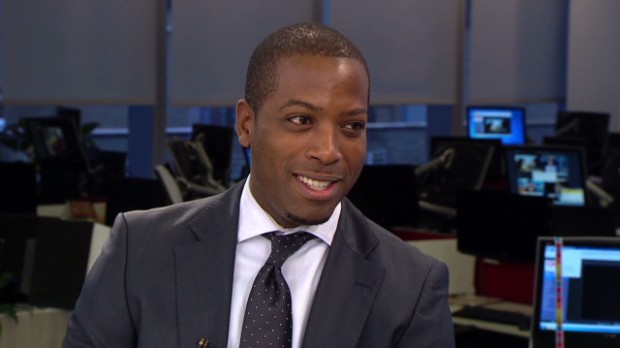 Techie makes a bet on a clean shave NEW YORK (CNNMoney) Tristan Walker is no stranger to the startup hustle.
  Vanguard's John Bogle Bloomberg

 ) reported its first quarter earnings, posting a 3% rise in sales over last year’s Q1 figure.